



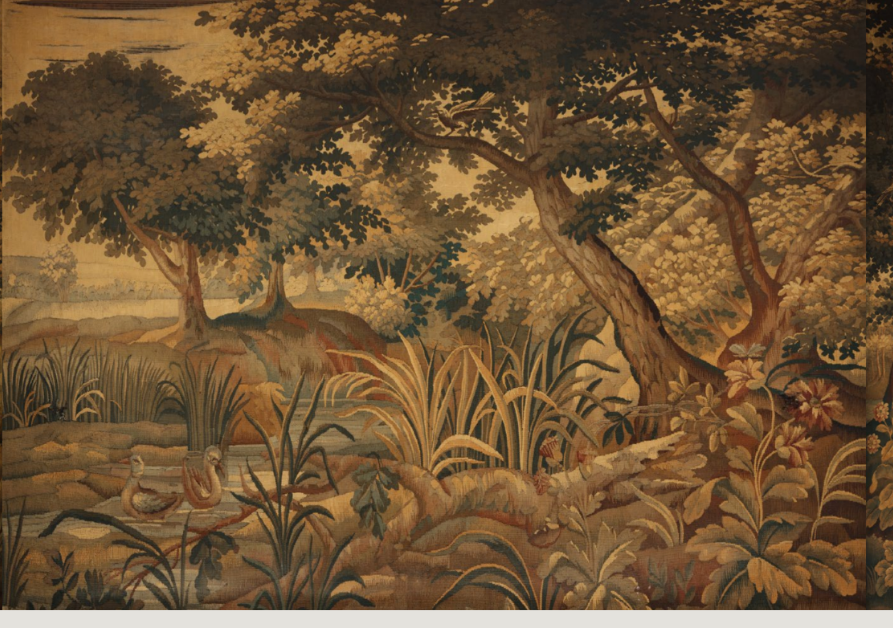
25 Aug 2025 August’s Office Artifact: Cushing Endicott House Tapestries
For the past 5 years, HBI’s office has been the unofficial home of 18th-century verdure tapestries that were removed from the Cushing Endicott House at 163 Marlborough Street in Boston’s Back Bay in 2020.
163 Marlborough was built by mason and builder James Devine from 1871-1872 for Thomas F. Cushing under the architects Snell & Gregerson. The panels are believed to have been installed in the late 1890s during a major interior redecoration under the then-new ownership of the Endicott family.
Of the six panels removed, four are hand-woven French Aubusson tapestries with foliate and scenic decoration, while two are machine-woven jacquard panels. The tapestries are constructed using a traditional Gobelin tapestry construction method of weft-faced plain weave slit tapestry technique. The warp threads are plied natural wool, and the weft threads are primarily dyed wool with highlighted details in dyed silk.
The beautiful tapestries came under HBI’s stewardship after one of our longtime Board members, Marcia Myers and her husband David, donated a preservation easement for the Cushing Endicott House to HBI in the 1980s. The Myers owned, resided in, and preserved the Cushing Endicott House from 1975-1984, donating a preservation restriction to HBI to ensure its preservation in perpetuity before they sold. HBI oversaw the careful removal of the tapestries in 2020 amid another interior redecoration and have been seeking a new home for them ever since.


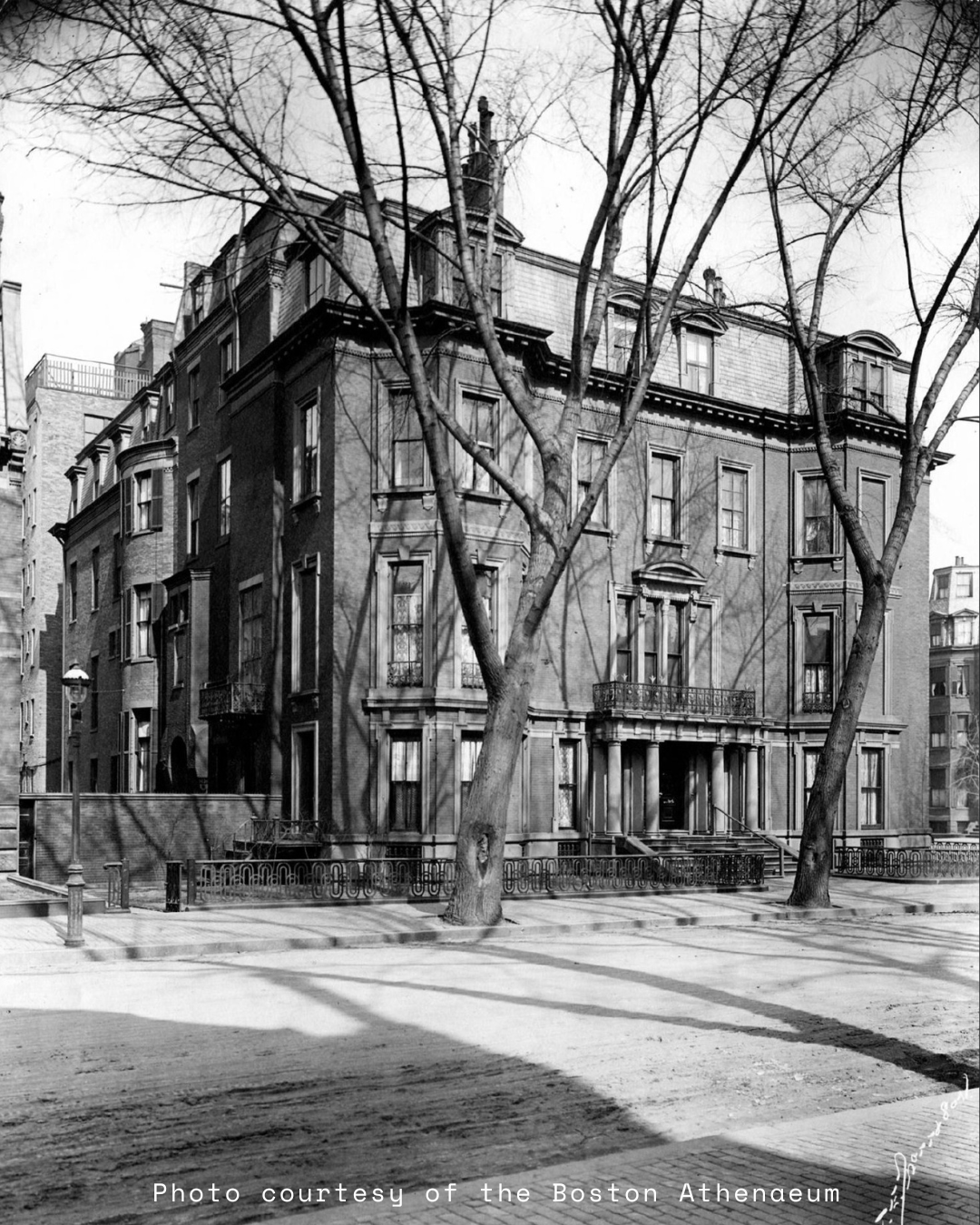
Cushing Endicott House, Back Bay Boston. Photo taken 1913 by Thomas E. Marr & Co., courtesy of the Boston Athenaeum.
