




31 Mar 2026 Walking in the footsteps of Anne Hutchinson: Women of the Old Corner
In 1634, Anne Hutchinson followed her spiritual leader, the Reverend John Cotton, to Boston, Massachusetts to live among their fellow Puritans and religious dissidents of the Church of England. Hutchinson and her family settled and built a home on the site of what is today the Old Corner Bookstore complex. Her home did not survive the fire of 1711. In 1718 Thomas Creese built the structure popularly known as the “Old Corner Bookstore.”
Trained as a midwife, Hutchinson was a sought-after healer within Boston’s community, extending spiritual comfort to those she treated. This eventually evolved into lecturing groups of women in her own home weekly as they sought from her what male preachers neglected to provide: biblical interpretation that put their souls on an equal plane with those of men. In her teachings Hutchinson also asserted that the ruling ministers preached a covenant of works rather than a covenant of grace: the theory that performing good deeds demonstrates your soul should be saved, rather than one’s salvation being predetermined by God’s grace. This theological distinction took center stage in her November 1637 trial.
Called before nine magistrates and thirty one deputies of the General Court of Massachusetts, Governor John Winthrop among them, in a thatched-roof meetinghouse in Cambridge where court was regularly convened, Anne testified that she had merely preached that other ministers did not teach a covenant of grace as clearly as Rev. Cotton. The court argued that she created a disturbance in the colony by disparaging the teachings of the ministers, to which she dared respond: “I say Sir, prove it.” She would not concede to their 82 charges against her and throughout her trial she laid bare that what was really at issue was a woman’s spiritual interpretation having more influence among the people than the ruling ministers. It was why her trial took place in Cambridge and not Boston, she had far too much support from her neighbors in town and those who knew her.
She was banished from the colony as “a woman not fit for our society.” Anne was allowed to remain throughout the winter, but was held on house arrest at a home in Roxbury before leaving the colony in March, 1638. She and her followers established a settlement in Portsmouth, Rhode Island, with the support of Roger Williams. In 1643, she and her family would be killed amid struggles between settlers of New Netherland and Wappinger and Lenape Indians in a conflict known as Kieft’s War.
Nathanial Hawthorne would allude to her unjust persecution by rigid Puritan society in the beginning of The Scarlet Letter (also published out of the Old Corner), aligning Hutchinson’s legacy with that of his heroine, Hester Prynne. Musing about a rose bush that has somehow continued to bloom at the entryway to the infamous Queen Street prison, Hawthorne “imagined [the rose] to offer their fragrance and fragile beauty to the prisoner as he went in…or whether, as there is fair authority for believing, it had sprung up under the footsteps of the sainted Ann Hutchinson, as she entered the prison-door.”
Governor Michael Dukakis formally pardoned Hutchinson in 1987, 300 years after her trial and banishment.
Somewhat prophetically, the feminist resistance Anne Hutchinson sowed at this site would be reaped by generations of women– writers by and large– that would come to the Old Corner, and the publishers therein, to challenge the many modes of inequality that were at odds with this nation’s founding ideals. Without further ado, here are the stories of some of the most influential women of the Old Corner Bookstore.
Lydia Maria Child
Child’s An appeal in favor of that class of Americans called Africans was published in Boston by Allen and Ticknor in 1833 (before Fields’ famously joined the firm in 1845). Printed by Tuttle & Weeks, Printers, at 8 School Street, this was Child’s most famous work and the one that led to her ostracization in the publishing world. It was the first abolitionist pamphlet to be published in book form in the U.S.

Louisa May Alcott
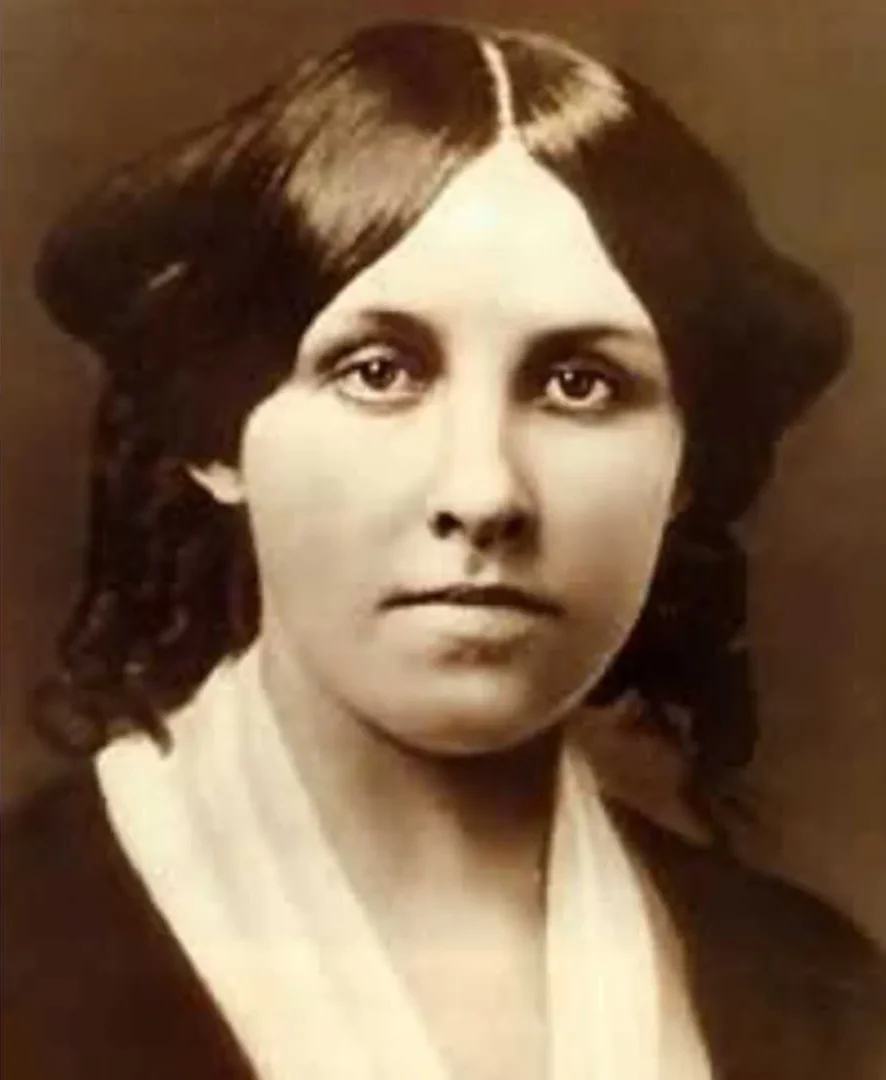
Most writers related to the Old Corner are famous for being published at this site by Ticknor and Fields, but Louisa May Alcott is the only one with an incredible story surrounding James Fields’ rejection of her work. While she did publish some stories in The Atlantic Monthly when the newspaper was housed onsite, it’s a common misconception that Ticknor and Fields also published Little Women. Read the story of Alcott’s “Pot of Gold” here.
Julia Ward Howe
Howe’s “Battle Hymn of the Republic” was published in The Atlantic Monthly in February 1862, which had been acquired by Ticknor and Fields in 1859. Howe’s poem reframed the cause for abolition in the Civil War into a holy crusade. Read historian Heather Cox Richardson’s analysis of Howe’s poem in light of the nation’s 250th here.

Harriet Beecher Stowe
Stowe’s anti-slavery bestseller Uncle Tom’s Cabin was first published in Boston by John P. Jewett & Company in 1852. Jewett and Co. left the publishing business in 1860, leaving the rights to Stowe’s novel to be acquired by Ticknor and Fields, who published her book out of the Old Corner Bookstore in 1862. It has been said that no other book in U.S. history had been as influential as Stowe’s in molding public opinion. In late 1862, Stowe met with President Lincoln to urge him to sign the Emancipation Proclamation and he was alleged to have greeted her with: “Is this the little woman who made this great war?”

Happy Women’s History Month!